
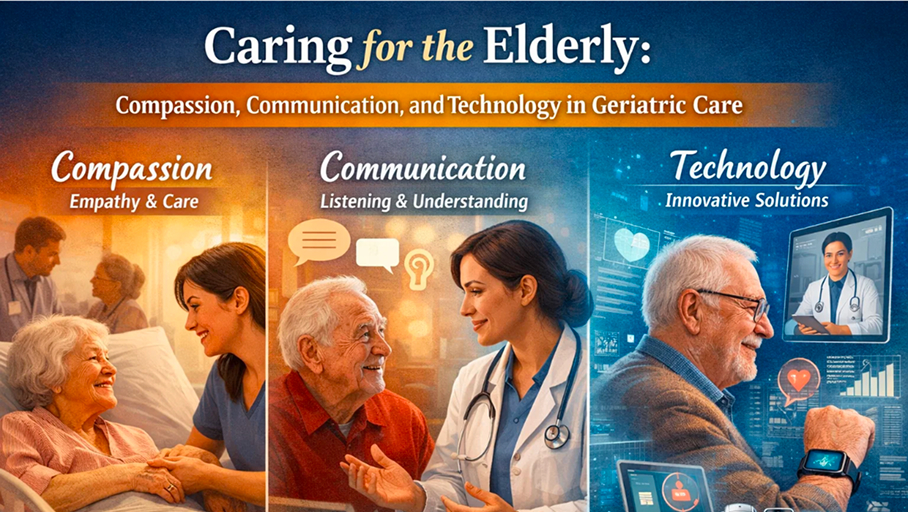
As the world’s elderly population is expected to grow significantly—set to triple in India alone by 2050—healthcare professionals face a critical challenge: How do we provide high-quality, compassionate care for a rapidly aging society? The responsibility goes beyond merely managing the physical health of elderly patients. It requires a holistic approach, integrating empathy, effective communication, and cutting-edge technology to address their complex medical and emotional needs.
Compassion: The Core of Elderly Care
At the heart of geriatric care lies the balance between clinical expertise and human compassion. Elderly patients often suffer from a combination of chronic illnesses, mobility issues, and cognitive decline, which can make them highly dependent on healthcare professionals. But care isn’t just about addressing symptoms or managing conditions—it’s about preserving dignity and offering emotional support to some of society’s most vulnerable individuals.
Imagine an elderly patient, confined to bed and struggling with both physical pain and a deep sense of isolation. For that individual, a healthcare professional’s presence can make the difference between feeling neglected and feeling supported. Doctors, nurses, therapists, and caregivers alike play a vital role in ensuring that elderly patients not only receive medical treatment but also feel valued and respected.
However, the fast-paced and resource-constrained environments that many healthcare professionals work in can make maintaining this level of compassionate care challenging. In such settings, it’s important to ask: Are we truly giving elderly patients the attention and care they deserve? How can we balance the demands of modern healthcare with the need for empathy?
Creating a culture of compassion across the healthcare spectrum—from physicians to social workers—ensures that elderly patients are not just treated but cared for in a way that values their dignity and emotional well-being.
Communication: The Foundation of Trust
While compassion forms the emotional backbone of care, communication serves as the bridge between healthcare professionals and their elderly patients. Aging patients often face barriers to communication—whether due to hearing loss, speech impairments, or cognitive decline—that can make it difficult for them to express their needs or concerns clearly. For healthcare professionals, effective communication in these cases can mean the difference between addressing a minor issue and preventing a major health complication.
Consider an elderly patient experiencing pain but unable to articulate the specifics due to advancing dementia. For healthcare providers, this requires not just clinical skills, but a heightened ability to observe, listen, and interpret non-verbal cues. How do you understand someone when words fail? This is where the ability to read facial expressions, interpret gestures, and listen beyond the spoken word becomes crucial.
Patience and active listening are critical here. When an elderly patient struggles to communicate, taking the extra time to observe their behaviour or listen to their concerns—however haltingly expressed—can help alleviate anxiety and build trust. And trust is the foundation upon which high-quality care is built.
Technological tools can also play a vital role in overcoming communication barriers. Devices like hearing aids, speech-generating tools, and communication apps can assist those with impairments, enabling them to express their needs more clearly. The integration of these tools into geriatric care ensures that patients remain active participants in their own healthcare, regardless of physical or cognitive limitations.
Clear communication is not only about ensuring patients understand their treatment plans, but also about showing them that their voices matter.
Technology: Revolutionizing Geriatric Care
As healthcare continues to evolve, the role of technology in geriatric care is becoming increasingly important. Innovations that once seemed like futuristic solutions—wearable health monitors, remote care systems, and AI-driven diagnostic tools—are now essential components of elderly care. These advancements not only improve the quality of care but also help healthcare professionals manage their workloads more effectively.
For example, wearable devices can monitor an elderly patient’s heart rate, sleep patterns, and activity levels in real time. Should an abnormality arise, healthcare professionals are alerted, enabling them to intervene before a minor issue becomes a major emergency. Remote monitoring systems offer elderly patients the ability to stay at home while receiving continuous medical oversight, reducing hospital admissions and alleviating the pressure on healthcare resources.
AI-powered health tracking systems can analyze vast amounts of data—from electronic health records to real-time monitoring devices—to predict complications and suggest personalized treatment plans. This data-driven approach allows healthcare professionals to take proactive steps in managing the health of elderly patients, improving outcomes while reducing the strain on already overburdened healthcare systems.
However, the rise of technology in geriatric care also brings its own set of challenges. How do we balance the use of technology with the human touch that elderly patients need? While machines can monitor and analyze, they can’t replace the compassion, empathy, and understanding that come from a face-to-face interaction with a healthcare professional.
Ultimately, technology should serve to enhance, not replace, the human elements of care. When used thoughtfully, it allows healthcare providers to focus more on what they do best—caring for patients directly—while using data and automation to streamline routine tasks and enhance patient safety.
Conclusion: A Holistic Approach to Elderly Care
The future of geriatric care lies at the intersection of compassion, communication, and technology. Healthcare professionals—whether doctors, nurses, physical therapists, or social workers—must continue to lead with empathy, actively listen to their patients, and embrace the innovations that are reshaping healthcare.
But while technology offers valuable tools, it’s essential to remember that elderly patients need more than just clinical treatment—they need to feel respected, heard, and valued. The healthcare system must evolve not only to meet the growing demand for elderly care but also to ensure that we are providing care that upholds the dignity of each individual.
As the world’s elderly population continues to grow, the best care will not only be defined by the latest technological advances but also by the compassion with which healthcare professionals deliver it.