
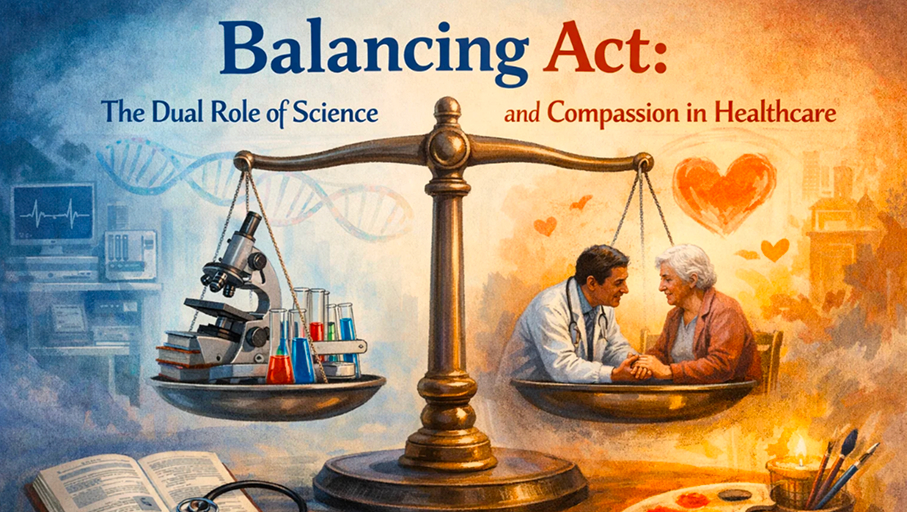
Last week, my friend brought her 89-year-old grandmother to my clinic. She had complaints that warranted invasive investigations. She came across as a strong woman and made it clear to me that she had no intentions to get admitted into a hospital either for testing or for treatment! Despite her firm stance, I knew it was essential to address her health concerns with utmost care and respect for her wishes. I took time to explain the importance of finding the diagnosis. But she was firm and refused to tow my line. I was at crossroads between the scientific approach and respecting the patient’s autonomy.
As a doctor, I am trained to systematically dissect a patient’s problems, look at the evidence, and find the best treatment options. But every now and then, there comes a patient when you need to step back and glimpse at the human being rather than the problem or disease.
It is in these moments of connection that the true essence of medical practice shines through. Beyond the lab results and medical jargon, there lies a person with a unique story, fears, and hopes. As healthcare providers, we have the privilege of not only treating illnesses but also offering compassion, understanding, and empathy.
Clinical practice is not all science; equally important is the art of patient interaction. As doctors we have the responsibility to shape the experience of our patients amidst disease and pain. This experience may not be enjoyable, but we could definitely contribute to an environment of support and solace to the patient and their family. Just as each artist expresses her own personality and being in her creation, each clinician by his approach, creates a unique patient experience.
Just as a painter uses assorted colours to evoke emotions, clinicians utilize their skills and compassion to bring comfort and healing to those in need. The art of medicine lies in the ability to listen, to empathize, and to understand not just the symptoms, but the person behind them. It is in these moments of connection and understanding that healing truly begins. Each patient we encounter is a blank canvas waiting to be filled with empathy, kindness, and hope. As clinicians, we strive to paint a picture of care and support, leaving a lasting impression that goes beyond the treatment itself. Just as a masterpiece can move the soul, our interactions with patients have the power to touch hearts and transform lives.
Where do doctors learn to approach such patients? These are grey areas in clinical practice, and we rarely find answers to these in textbooks or scientific journals. It is learnt from mentors and from careful observation of innumerable human conditions. In clinical practice doctors are privileged to witness the emotional upheavals, insecurity of life and the certainty of death. In and through all these, we learn the art of listening, appreciation of inner fears, and sharpen our “soft skills,” ever careful not to abandon the process of scientific inquiry.
It is essential to have an individualised approach. Understanding that each individual is unique and may require a different approach is crucial in providing the best care possible. By observing and learning from experienced mentors, as well as from our own experiences, we can develop the ability to listen attentively, understand their fears, and offer support in a way that is both scientifically sound and emotionally sensitive. It is through this delicate balance of science and empathy that we can truly be effective in the lives of those we care for.
Similarly, there cannot be a general advice for medical practitioners on this approach. Each doctor has to craft his own unique approach. As a surgeon, I am shaped by my mentors, training, and experience, I also draw upon my inner resourcefulness, intuition and lessons learnt. Even after thirty odd years of experience, I still face dilemmas constantly with patient encounters and in various aspects of my practice. As a surgeon, I have to continuously balance the delicate dance between science and humanity. It is more than just incisions and sutures; it’s a profound intersection of life, ethics, and conscience. As a surgeon and a doctor, I am bound by an ancient oath—a tradition that is etched in time: “To do no harm, to serve with honour.” It is the compass guiding my hands, my conscience, my very essence. But the reality of clinical practice is so uncertain and riddled with dilemmas. I have tried to crystallise my experiences of dilemmas in a poem:
In the din of life monitors in the OR
Grappling with challenges new and more,
Must decide my choices, the next step
Why aren’t answers neatly wrapped?
How do I decide what is next?
Away from the OR in my bed
sleepless nights replaying the steps
Whispers from past surgeries stirring
Did I choose wisely?
Did I honour my patient’s trust?
Patient’s eyes searching mine for answers
Truth so painful, the kindest incision?
Or so brutal to wreck the psyche
How much do I know? How much do I reveal?
How gently should I wield the blade of reality?
Consent, a sacred pact
I see their trust in my eyes
Risks, benefits, and alternatives
What if my knowledge is inexact?
Do I reveal I don’t call all the shots?
Competence not a onetime event
Learning and improving every day
In areas where my hands aren’t that deft
Do I accept that vulnerability?
Have the humility to call for help?
Compassion is the foundation
I am as much a healer as a surgeon
Must blend science with kindness
Did I do this for everyone?
How many times have I forgotten?
The practice of medicine is an intricate balance between scientific precision and compassionate care. The challenges we face may not always come with straightforward solutions, but through experience and mentorship, we learn to navigate these grey areas. Each patient encounter is a unique canvas, demanding both our clinical expertise and our humanity. As doctors, we must continually refine our approach, embracing vulnerability, seeking help when needed, and always striving to honour the trust our patients place in us. It is this delicate interplay of science and empathy that defines true healing and makes the journey in medicine profoundly meaningful.